
Reader’s Forum
by Susan Antoft
Do you know any team that hasn’t at least one clown? The individual who is always ready with the jokes, the biggest grin, the one always at the centre of mischief.
Canada’s rowing team is no exception. In fact, we have two clowns and both are in the women’s pair-without. A dangerous combination, eh?
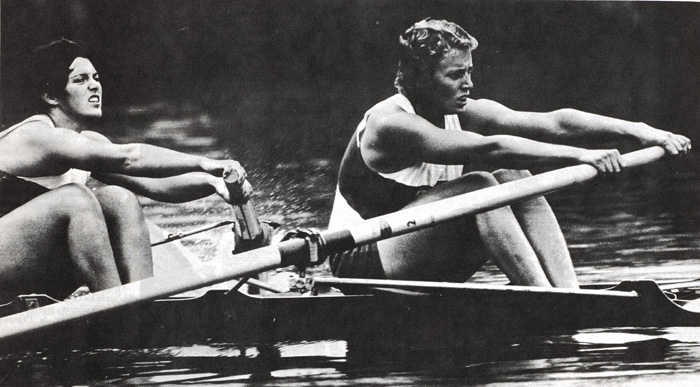
STRAIN, TENSION AND HARD TRAINING paid off for Betty Craig (I) and Susan Antoft as they row towards a bronze medal at the 1977 World Championships.
DE LONGUES HEURES d’entraînement et d’efforts sont récompensées par une médaille de bronze pour les rameuses Betty Craig (g.) et Susan Antoft aux Championnats du Monde d’Aviron 1977.
Well, it just so happens that I’m the number two prankster. Numéro Uno is Betts, also known as Betty Craig. She’s a powerhouse with the biggest, brownest eyes you ever saw, *‘My mother is a cow!” (only kidding, Mom), all of 5’8″, so her driving licence states. That makes me two inches taller, but my mother didn’t give me bovine eyes.
The women’s pair seems to be synonymous with trouble. We don’t even have to go looking for it. Just before we left for Europe this past summer, Betts found it first. Not so funny this batch—cycling up a hill with her visor pulled low, she backended a parked transport. It escaped damage, but Betts had stitches around her right eye and a face like a rainbow. All she needed was plastic fangs — that would have really scared our competition!
Item two. We had just won the West German Championships on the Olympic course in Munich. We collected our medals. Then, during the rowpast, we became entangled with rigger and oar on a gigantic flagged buoy, in full view of the grandstand. After several minutes we finally freed ourselves to great rounds of applause and cheering. How embarrassing!
Then there was the time we were practising a hot dog move (watch out, skiers)! It’s called the “one foot push off’ ’ and is not hard to do in a boat such as an eight or a four because they have more oars to be flat on the water for more stability. A little shakier in a pair. We’ve got one foot on the dock, one foot on the support work in the boat, a crouch vaguely like that of a sprinter’s start. The boat is tipped away from the dock, supported by the opposite oar on the water (in our case, mine), the other clear of the dock so we can push away. The idea is to clear the dock and maintain our precarious balance. In my haste to get it over with, I neglected to close the pin that keeps my oar in the lock. The order of events was: we shoved off, my oar popped out of place, the boat continued-to lean and lean and lean, and over we went! All in slow motion. And with the New Zealand team watching. Elite athletes???
Even after two sessions on the water, and one with weights, by 9 p.m. Betts was always up for a little basketball (she’s pretty good, my talents are best left undescribed). The scouts for the Japanese rowing team and the West German kayak team arranged some good matches for us. The games went 1-1, oarswomen vs visitors (males). All I can say about it is have you ever seen a 5’7″ (sorry 5’8″) trying dunk shots?
We added a little colour to our warmups, namely green. We turned squat jumps into fighting frogs, complete with bulging eyes, webbed fingers, and of course, rivet, rivet. Are we serious about training or are we the side show? Some Aussie once figured us as the spares.
Was it Bett’s smile or her nifty Canadian rowing pin that attracted those Russian guys? The pin, eh? They wanted it so badly that they started dragging her off with it. If I hadn’t fought them off, I would have had to row solo. With the help of a translator, we tried to bargain with these guys. One pin for a sweatsuit (da! da!) and our choice of four of their best looking oarsmen (nyet! nyet!)
If you are ever in Ottawa and need a good joke, look us up. We’ve got a good collection. From Little Red Riding Hood to John Wayne to parrots that haven’t got any legs. Most wouldn’t make it past the editors of this rag though!
Now don’t get the wrong idea about us. We are the happiest pair on the team, but on the water we’re deadly serious about putting the quality. The joking around just make the months of camp life a lot less tense and draining. We like to entertain and be entertained.
We’re pretty cocky. We’re not conceited — just very positive about what we can do. We were not even the Number One boat as far as coaching priorities go. Our first coach was going for the eight. We were his “orphan crew”. To give you some history, in 1976, the eight, my boat, just missed a bronze to the Americans. In 1977, everyone was training to be in a better, faster eight. The pair in ’76, Bett’s boat, hadn’t lived up to gold expectations and there were no great plans for it in ’77. I wanted to be in the eight again. But a few days before the case of B. Craig vs Smith Transport, we were ordered to be the pair. A surprise and we had to race two weeks later! We decided to make that pair smoke and forget about the politics and personalities elsewhere. With our new coach, Ana Thomas, we trained to race for nothing less than first place. Who would believe it if they saw us on our continuous cruise for a bruise?
We arrived at the World Championships in Amsterdam. In our heat, we broke the course record and went straight to the final. Ditto for the East Germans in the second heat. At this time, we lost most of our joviality and started the triple doses of antacids.
Thus far we had outshone our teammates, so all of a sudden we were an endangered species. We even got seconds on dessert. Betts discouraged my gentlemen callers, “She’s mine until Saturday. After that. . . .” If we were caught standing up unnecessarily, there were orders to put us on our asses, gently. Ana was always whisking us away from the course after our showers. Once, when she had her back turned, we escaped, but it was also the one time when none of our buddies were around to visit. Some freedom!
Race day. We asked that we be left alone by almost everyone and we avoided the rest. Good thing the press wasn’t thick like it was in Montreal. We were pretty sick with nerves and fear. We just wanted to race our very best. In 1976, the women’s pair had also gone straight to the final after the heat, and also were in contention for the gold. Betts often recalled the great pressure by the media and by well-wishers. She had nightmares of their bad start and steering problems by her partner. They came fifth. We didn’t need any of that. I did not want to let her down.
Things weren’t helped much by our friends and supporters. An American coach I knew, “I’ve got money on you two”. A fellow teammate, “You’re the only ones who can get the East Germans. You gotta do it for the rest of us, and for Canada.” Another couple of antacids.
We raced with … it may sound silly . . . courage. We were like the Cowardly Lion in the Land of Oz. We didn’t get the gold but came up with the bronze; the first rowing medal since the days of George Hungerford and Roger Jackson in the pair-without in Tokyo. Our boatman said that if any crew was going to win a medal it would be us the way we had been carrying on.
All we want is another chance to go after the gold again next year. We’ll be back as our usual frolicsome selves. It certainly keeps us going.
A native of Halifax, Susan Antoft, 23, won a bronze medal in pairs without cox at the 1977 World Rowing Championships. Her partner is Betty Craig of Brockville, Ontario. Antoft, a computer programmer, is a graduate in mathematics from Dalhousie University. She began rowing in 1974 and has been a member of the national team for two years.