
Champion interview: Nancy Garapick
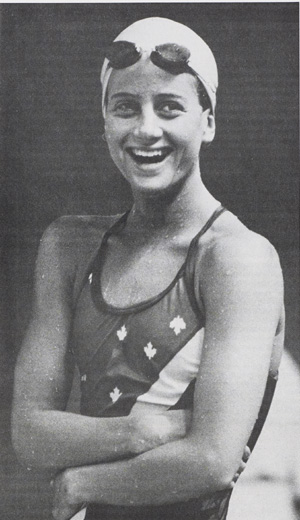
Nancy Garapick, former world record holder in 200 m backstroke (see April 27, 1975) and winner of two 1976 Olympic bronze medals (100 m and 200 m backstroke) recently relinquished her athletic scholarship at the University of Southern California (USC) and returned home to Halifax. Garapick, 19, plans to study physiotherapy at Dalhousie University in the fall. This summer she is training in Edmonton under national coach Dave Johnson. En route from Halifax to Edmonton in May, Garapick stopped off in Ottawa where Champion’s David McDonald talked with her about her career and about her decision to return to Canada.
CHAMPION: What was behind your decision to give up your scholarship and return home?
GARAPICK: It was mainly to do with the USC training program. It was completely different from the program I was used to. So my swimming wasn’t going well and that was the main factor in my coming back.
CHAMPION: What was the difference in your training?
 GARAPICK: At USC it was a lot of over-distancing, a lot of Nautilus, a lot of running, and a lot of yardage in the pool. The program I was used to (at Halifax’s Trojan Aquatic Club under coach Nigel Kemp) didn’t have a lot of weight training. The emphasis was on technique work, on always trying to be as efficient in the water as you can. We emphasized speed work and race work, whereas at USC the idea was that the only way to get in shape was to pound in those yards in the pool. That approach makes you feel strong outside the water. You feel you can run as long as you want.
CHAMPION: Great for your tennis game?
GARAPICK: Yes, but in the water there was no speed. And I lost a lot of flexibility from doing weights so much. Also, muscle is denser than fat so it pulls your body down. You sink lower in the water. So there were a lot of little factors that you never really think about at the time. The effects of a different program aren’t apparent until much later. It was such a gradual thing that you start wondering what’s happening to you. Then you begin to realize that you’ve been doing too much of this or too much of that. But the process of going back and undoing things is just as long. So it’s a Catch-22 type of situation.
CHAMPION: How much weight did you put on with the USC weight program?
GARAPICK: Twenty lbs. I didn’t realize it. It was such a gradual change. Our coach was very big on Nautilus and we did too much.
CHAMPION: Was the Nautilus training a kind of fad or some kind of bandwagon the USC coach jumped on?
GARAPICK: I think the idea was that Nautilus was a good thing, so do Nautilus — but not how to do Nautilus so that it works for you. So you’re just pumping away, getting sore, tired, but you’ve been brainwashed that it’s the right thing to do. When I finally realized it wasn’t right for me, it was hard to believe because the whole team was doing it. But it’s the type of situation you could run into anywhere. You have to entrust your performance to your coach. If he believes in something then you have to, too, even though it may not be right for you. You see, that’s why it all goes back to being with someone who knows you, someone you’ve come through the years with. That’s why it’s really tough to move on to a university team. You don’t realize what you have until you no longer have it.
CHAMPION: When did you first realize something was wrong?
GARAPICK: Last summer when I swam really badly on the Olympic tour. My strokes felt different. But I went Brian Gavriloff back to school. It seemed like the obvious thing to do, so I just went. I thought maybe I could change things and I did talk to the coach a number of times. But he’s been coaching like that for 10 or 15 years.
CHAMPION: They didn’t tailor their program at all to individual needs?
GARAPICK: They can’t because they have a team numbering around 23 or 25 and everybody’s coming from a different program. And the program we had in Halifax is a lot different from most others. In fact, a lot of people have asked, “That works?!” My coach at USC didn’t really understand it, so it was questionable in his mind that he should change his programs to suit one swimmer.
CHAMPION: Do you consider your time at USC a waste, at least as far as swimming goes?
GARAPICK: No, because the experience was beneficial. It made me realize what I do need in training. It was really frustrating for a year and a half not being able to do what I thought I should be able to do. That was about the only bad thing. If I hadn’t gone I would always have wondered whether I should have. There are a lot of Canadians swimming in the States and some are having a good experience, some aren’t.
CHAMPION: It would seem, at least, that a lot of Canadian swimmers aren’t. Why is this?
GARAPICK: For one thing it’s a really big change going from high school and a coach you’ve trained with for six or seven years to a completely different program with a lot of new attractions on the outside. It’s tough getting adjusted to college — that might have something to do with it in your freshman year. Another thing I really noticed is that you’re a Canadian in another country. The Americans come first and the Canadians only after the Americans have been looked after. And you’re cut off from the Canadian sports system, where you’ve had so much help in the past.
CHAMPION: So the two systems don’t mesh quite as well as many might imagine?
GARAPICK: No. For instance, if you want to be selected for an international meet you have to go to a certain number of Canada Cup events. That means travelling from school. So you have the disadvantages of missing school and being away from your American school team. It’s a lot more comfortable being in Canada and knowing the system, too, knowing who to get in touch with if you need help, and knowing what kind of aid will be there for you. The Americans have no such thing as Sport Canada’s Athlete Assistance Program or the Competitive Opportunities Fund of the Canadian Amateur Swimming Association. And, of course, the US scene is geared towards the university championships. If you want to keep training after these are over then you have to arrange some kind of special program until school ends. But if your coach is not intent on staying and training you, then where do you go? A lot of swimmers have faced that situation and they just stop swimming after the university championships because it’s a lot easier. It means you don’t have to go searching for a place to train and a coach to train you. But you also know you have to be in shape to make the team in Canada and yet there isn’t a coach there who realizes that. In Canada you might come up against the same problem — trying to find a place to train — but our coaches know you’re a swimmer who’s going to do something for Canada and they’ll stay around to train you.
But there are so many things you know when you come back. It’s like going on a trip: you say to yourself, Oh, I should have brought this, I should have brought that. It’s the same after you go to university down there. You realize you should have asked this or that question before you went. I think it has changed a bit but when I went they wouldn’t pay your way down to check out the campus, so you were really just looking at pictures and reading between the lines to see if you could make it at a particular university. If your times are fine and they think you can do well in their program they offer you the full ride.
CHAMPION: Do you think it’s a mistake for Canadians to follow the scholarship route then?
GARAPICK: No, not a mistake. If you get into a good program with a coach who understands you as an athlete, student and person, then you’ll do fine. But if you’re not happy it won’t work for four years. I sort of cringe now when I see people getting totally immersed in that American recruiting scene. It really is a glamorous thing. It’s very flattering to have schools calling you saying, We can give you this, we can give you that, you’re fantastic, we want you. Canadian schools don’t really do that. The temptation to go down to the States is very big.
CHAMPION: What was the transition like, going from swimming basically as an individual in Canada to being part of a college team in the US?
GARAPICK: It’s really a big psyche thing down there. To some people it may even be more important than an Olympic Games because there’s so much pride in the school team. Points ride on everybody’s placing. It’s a cut-throat style. You’ve got to get these points for the team.
CHAMPION: Did you find it difficult to surrender to that team emphasis?
GARAPICK: No, it’s very easy to get carried along with it because you’re really motivated to have the team do well. It’s being a USC Trojan and you’re really proud to be a Trojan. The way you win is through a team, not through yourself. What counts is the points. It was a big change for me to finally realize that if you came first and won the points, well, good, but it didn’t matter what time you did. Yet it had always seemed so important to me that you could go faster. Down there you had to get the placings and the points. It didn’t matter how well you swam. That was kind of hard to take.
CHAMPION: Did any Canadian universities actively recruit you?
GARAPICK: No.
CHAMPION: Not one?
GARAPICK: No.
CHAMPION: How many US schools got in touch with you?
GARAPICK: Ten or so, I guess.
CHAMPION: Why do you think Canadian universities react, or fail to react, the way they do?
GARAPICK: I think they just assume you’re going to go away.
CHAMPION: Some would say a typical Canadian attitude
GARAPICK: Yes, but it’s getting better now. A lot of Canadian universities are getting in there and letting the athlete know that they’re concerned about where they decide to go.
CHAMPION: Do you think there’s going to be a trend to staying at home?
GARAPICK: I think so. I think it’s starting to get to the point where Canadians who go down to the States — I shouldn’t say, aren’t doing well — but they seem to go along at the same pace they have been. And you don’t really hear too much about them. It’s going to improve in Canada, I’m sure, because a lot of athletes are staying and the level of swimming is going to rise. That’ll keep the athletes more motivated to stay in the college system in Canada.
CHAMPION: What advice would you give to the athletes who will inevitably go to the US anyway?
GARAPICK: Just know what you’re getting into before you sign anything. If you’re going to make that commitment, you’ve got to think of it as four years. You’ve got to know everything ahead of time about that swimming program, what the coach is like, whether the program is going to suit you. And you have to know whether your coach is going to support you as a Canadian and not just as a university team member.
CHAMPION: Everything considered though, it still must have been difficult for you to give up a full scholarship.
GARAPICK: In a way it was. It seems, I guess, to everybody that California is a great place to be. And the schooling was very good and the environment was great, but there was just one thing that wasn’t right and that made everything seem wrong. Being with Nigel (Kemp) I’ve always found that if you’re going to do something, it’s best to do it to the fullest. But when you can’t believe in something, you can’t put 100 per cent into it. I didn’t believe in the USC program and there was no way, I knew, that I’d do well for that program or for myself. So there was no point in wasting time.
CHAMPION: Did you encounter any problems in transferring to Dalhousie?
GARAPICK: I was in the physiotherapy program at USC but none of my credits are transferrable to Dalhousie. So I’ll have to start all over again, which you could say is a waste of two years. But it’s not really, because they tell me I’ve at least got a headstart on the courses I’ll have to take at Dal (laughs).
CHAMPION: All this and you had a broken arm last year, too. A lot of swimmers have quit much younger than you without suffering the setbacks you have. What keeps you at it?
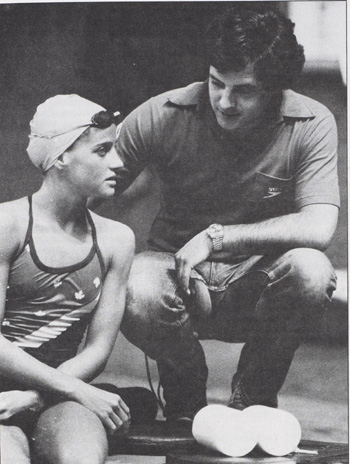
National swim coach Dave Johnson discusses training strategy with 1976 double Olympic bronze medallist Nancy Garapick.
L’entraîneur national de natation Dave Johnson discute de la stratégie d’entraînement avec Nancy Garapick, double médaillée de bronze aux Jeux olympiques de 1976.
GARAPICK: I guess it’s just knowing inside you that you can do better than you’re doing. It’s something to strive for. I know that after a year-and-a-half setback I’m just starting to get going again. It’s exciting to feel better in the water. That’s motivation in itself. I feel that I can improve my times if I give it a good try. So I’d like to.
CHAMPION: But you’ve been at it more than half your life
GARAPICK: That’s true. I’m so used to it being there that I can’t say goodbye to it that easily.
CHAMPION: Could you see yourself going until 1984?
GARAPICK: I don’t know. It’s funny because in 1976 a lot of people asked me if I’d go to ‘80. That seemed a long way away. But it goes really fast, it’s surprising. School, nationals, vacation — and you start again and it’s a year gone by. And there are only four of these cycles between Olympics.
CHAMPION: You were 13 when you set your world record, and 14 when you won two Olympic medals. How do you look back on that period of your life? GARAPICK: When I look back I see what went on, but I don’t really feel what I did then. The feelings fade after awhile. In ‘76 I don’t think we felt that much pressure because the most of the girls on the team were very young. We read the papers and everything, but we just went out to have a good time and swim our best. That attitude really helped because we were relaxed.
CHAMPION: What kind of expectations did people have of you then?
GARAPICK: I think that people try to build you up to do the best you can or what they think you can do, because they think, here we might have a chance for a gold medal. It’s like a rumour that keeps building on itself. You’re just doing what you’ve always done, but with all these people saying that you can do something that’s not really your goal. It’s not that you’re not capable of winning a gold medal, you’re just not thinking in those terms. Your goal is to go in there and do your best. What comes along with it in medals or labels is just something that comes along with it!
CHAMPION: How do you feel about your career since the ’76 Olympics? Do you ever feel that maybe you peaked very young?
GARAPICK: No. I think swimmers can go on as long as they want, go as fast as they want. What matters is knowing what you need. Really, every year has its ups and downs. You don’t look at a certain year and say it was your best year. It might be your best in a certain event, but you have three or four other strokes to work on and you can improve in those. There are quite a few things to do in each year of swimming. And it really teaches you a lot of self-discipline, how to handle yourself in various situations. So if you get into a pressure situation outside of sport you can handle yourself so much better. I think the major thing is self-discipline. Swimming’s such an individual sport and you have to cope with your own aches and pains.
CHAMPION: What’s been the most memorable part of your career so far?
GARAPICK: That’s so hard to answer because it seems like the Olympics were such a big thing that it should be what sticks out in my mind. And it does very much because it was a good experience I’ll always remember, but I think it’s more the meet-by-meet experiences that you have, such as meeting friends and travelling to different places and learning about the world and yourself. You learn so much more than sitting in a classroom or seeing it on a movie screen.
CHAMPION: Are you nervous about having to “start again?” What if it doesn’t quite work out?
GARAPICK: I’ve had so many disappointments in a year and a half that anything’s going to be better. I don’t think it can get much worse than it was so I’m keen to give it a try.
“. . . un Canadien dans un autre pays.’’
Champion rencontre Nancy Garapick
Nancy Garapick, ex-détentrice du record du monde au 200 m dos (établi le 27 avril 1975) et double médaillée de bronze aux Olympiques de 1976 (100 m et 200 m dos), renonçait récemment à sa bourse d’études sportives à l’Université de Southern California (USC), et rentrait chez elle, à Halifax. Âgée de 19 ans, Garapick a l’intention de poursuivre des études en physiothérapie à l’Université Dalhousie l’automne prochain. Cet été, elle s’entraîne à Edmonton, sous la direction de l’entraîneur national Dave Johnson. En route vers Edmonton depuis Halifax, Garapick s’arrêta à Ottawa, où David McDonald de Champion discuta avec elle de sa carrière et de sa décision de rentrer au Canada.
CHAMPION: Qu’est-ce qui a motivé votre décision de renoncer à votre bourse d’études et de rentrer au Canada?
GARAPICK: Principalement le programme d’entraînement de l’USC. Il était complètement différent de celui auquel j’étais habituée. Je ne nageais plus très bien et c’est la raison majeure de mon retour.
 CHAMPION: Quelle était la différence dans votre entraînement?
GARAPICK: À l’USC, il y avait beaucoup de distances plus longues, beaucoup de Nautilus, beaucoup de course, et beaucoup de longueurs de piscine. Le programme auquel j’étais habituée (au Trojan Aquatic Club d’Halifax, avec l’entraîneur Nigel Kemp) ne comportait pas beaucoup de musculation. On travaillait surtout la technique, et à être aussi efficace que possible dans l’eau. On insistait sur la vitesse et la course, alors qu’à l’USC on vous dicte que le seul moyen de se mettre en forme est de couvrir toutes ces verges dans la piscine. Ce genre d’approche vous rend fort hors de l’eau. Vous croyez que vous pouvez courir aussi longtemps que vous le voulez.
CHAMPION: Excellent pour le tennis?
GARAPICK: Oui, mais dans l’eau, ça n’aide pas la vitesse. Et j’ai perdu beaucoup de souplesse à faire autant de musculation. De plus, les muscles sont plus denses que la graisse, ce qui rend votre corps plus lourd. Vous vous enfoncez davantage dans l’eau. Il y a donc beaucoup de facteurs mineurs auxquels vous ne pensez pas vraiment sur le coup. Les effets d’un programme différent ne se font sentir que beaucoup plus tard. C’est tellement progressif que vous commencez à vous demander ce qui vous arrive. Puis vous vous rendez compte que vous avez fait trop de ceci ou trop de cela. Mais le processus de retour en arrière est tout aussi long. Il n’y a pas moyen de s’en sortir.
CHAMPION: Combien de poids avezvous pris avec le programme de musculation de l’USC?
GARAPICK: Vingt livres. Je ne m’en suis pas rendu compte. C’était un changement tellement progressif. Notre entraîneur était converti à Nautilus et nous en avons trop fait.
CHAMPION: L’entraînement Nautilus était-il une manie passagère, ou une mode que l’entraîneur de l’USC avait adoptée?
GARAPICK: Je crois qu’en fait, il suivait le principe: Nautilus est un bon programme donc faites du Nautilus, mais sans penser à s’en servir à notre avantage. Ça se limite à pousser des poids, être endolorie, fatiguée; mais on vous a convaincue que c’est ce qu’il faut faire. Lorsque je me suis finalement rendu compte que ça ne me réussissait pas, ce fut difficle à croire parce que c’est ce que faisait toute l’équipe. Mais c’est le genre de situation que vous pouvez rencontrer n’importe où. Il vous faut confier votre performance à votre entraîneur. S’il est convaincu de quelque chose, il faut que vous le soyiez aussi, même si ça n’est pas bon pour vous. Voyez-vous, tout revient à être avec quelqu’un qui vous connaît, quelqu’un qui vous a suivie pendant des années. C’est pourquoi c’est vraiment très difficile de passer à une équipe universitaire. Vous ne vous rendez compte de ce que vous avez qui, après l’avoir perdu.
CHAMPION: Quand avez-vous compris que quelque chose n’allait pas?
GARAPICK: L’été dernier, où j’ai vraiment mal nagé pendant la tournée olympique. Je sentais que mes mouvements étaient différents. Mais je suis retournée aux études. Cela semblait logique, et c’est ce que j’ai fait. Je croyais que je pourrais peut-être changer, et j’ai discuté avec l’entraîneur plusieurs fois. Mais il y a 10 ou 15 ans qu’il utilise ces méthodes.
CHAMPION: Ils n’adaptent pas leur programme aux besoins des individus?
GARAPICK: Ils ne peuvent pas, avec une équipe de 23 ou 25, où chacun a eu un programme différent. Et le programme que nous avions à Halifax est très différent de la plupart des autres. En fait, plusieurs m’ont demandé “Ça marche?’’. Mon entraîneur à l’USC ne le comprenait pas vraiment, donc il n’était pas convaincu qu’il devrait changer son programme pour accommoder un seul nageur.
CHAMPION: Croyez-vous avoir perdu votre temps à l’USC, du moins au point de vue de la natation?
GARAPICK: Non, car j’ai profité de l’expérience. Cela m’a fait comprendre mes besoins d’entraînement. Ce fut très frustrant pendant un an et demi de ne pas pouvoir accomplir ce que je croyais être capable de faire. C’est probablement le seul mauvais point. Si je n’étais pas allée, je me serais toujours demandé si j’aurais dû. Il y a beaucoup de nageurs canadiens aux Etats-Unis. Certains y rencontrent de bonnes expériences, d’autres pas.
CHAMPION: Il semble que beaucoup de nageurs canadiens ont eu des expériences négatives. Pourquoi?
GARAPICK: Tout d’abord, c’est vraiment un gros changement de laisser le secondaire et un entraîneur avec qui vous avez travaillé depuis six ou sept ans, et de trouver un programme tout à fait différent et beaucoup de nouvelles attractions à l’extérieur. C’est difficile de s’acclimater au collège, c’est peut-être ce qui vous arrive au cours de la première année. Autre chose que j’ai remarquée, c’est que vous êtes un Canadien dans un autre pays. Les Américains ont priorité et les Canadiens passent après qu’on se soit occupé des Américains. Et vous êtes isolé du système sportif canadien, qui vous a tellement aidé auparavant.
CHAMPION: Les deux systèmes ne se combinent pas aussi bien que beaucoup imaginent?
GARAPICK: Non. Par exemple, si vous voulez être choisi pour une rencontre internationale, vous devez participer à un certain nombre d’épreuves de la Coupe Canada. Ce qui veut dire des déplacements. Vous êtes donc désavantagée en manquant des cours et en étant éloignée de votre équipe scolaire américaine. C’est beaucoup plus confortable d’être au Canada, où vous connaissez le système; vous savez qui contacter en cas de besoin, et vous savez quel genre d’aide vous attend. Les Américains n’ont rien du genre du Programme d’aide aux athlètes de Sport Canada, ou le Competitive Opportunities Fund de l’Association Canadienne de Natation Amateur. Et évidemment, le système américain est fonction des championnats universitaires. Si vous désirez vous entraîner une fois qu’ils sont terminés, vous devez organiser un programme spécial jusqu’à la fin de l’année scolaire. Mais si votre entraîneur n’est pas intéressé à rester et vous entraîner, que faites-vous? Plusieurs nageurs ont dû faire face à cette situation et ils cessent tout simplement de nager après les championnats universitaires parce que c’est beaucoup plus facile. Cela vous évite de trouver un endroit où vous entraîner et un entraîneur avec qui travailler. Vous savez aussi qu’il vous faut être en forme pour faire partie de l’équipe canadienne mais aucun entraîneur là-bas ne reconnaît cela. Vous pourriez rencontrer le même problème au Canada, de trouver un lieu d’entraînement, mais nos entraîneurs savent que vous êtes un nageur qui produira des résultats pour le Canada, et ils resteront pour vous faire travailler.
Mais vous avez tellement appris lorsque vous revenez. C’est comme partir en voyage. Vous vous dites: “J’aurais dû rapporter ceci et cela”. C’est la même chose d’aller à l’université là-bas. Vous comprenez que vous auriez dû vous poser toutes ces questions avant de partir. Je crois que les choses ont changé un peu, mais, au moment où j’y suis allée, ils n’acceptaient pas de payer votre voyage pour visiter le campus. Il n’y avait que quelques photos et il fallait essayer de lire entre les lignes pour juger de vos chances dans une université. Si vous avez de bons temps et s’ils croient que vous pouvez réussir dans leur programme, ils sortent le tapis rouge.
CHAMPION: Croyez-vous donc que les Canadiens font une erreur en acceptant les bourses d’études?
GARAPICK: Non, pas une erreur. Si vous faites partie d’un bon programme où l’entraîneur vous comprend en tant qu’athlète, étudiant et personne, alors tout ira bien. Mais si vous n’êtes pas satisfait, ce sera pour quatre ans. Cela me fait peur maintenant lorsque je vois des personnes complètement absorbées par le système de recrutement américain? C’est vraiment fascinant. Il est très flatteur que des établissements vous téléphonent, vous fassent des tas d’offres, vous trouvent fantastique, vous demandent. Les établissements canadiens ne font pas cela. La tentation d’aller aux Etats-Unis est très forte.
CHAMPION: Comment s’est effectuée la transition? Nageuse pour ainsi dire individuelle au Canada, vous êtes rentrée dans une équipe universitaire aux Etats- Unis.
GARAPICK: C’est quelque chose de très psychologique, là-bas. Pour certains, c’est même plus important que les Jeux olympiques car il y a tellement d’orgueil rattaché à l’équipe collégiale. Les points sont basés sur les résultats de toute l’équipe. C’est un genre coupegorge. Il faut compter des points pour l’équipe.
CHAMPION: Avez-vous trouvé difficile de vous adapter à cette importance donnée à l’équipe?
GARAPICK: Non, c’est très facile de vous laisser emporter parce que vous voulez vraiment que l’équipe ait de bons résultats. Vous êtes un Trojan de l’USC et vous en êtes fier. Vous gagnez grâce à l’équipe, mais pas individuellement. Ce sont les points qui comptent. Ce fut vraiment un gros changement de me rendre compte que si vous vous placez première et gagnez des points, et bien tant mieux, mais le temps a peu d’importance. Et pourtant j’avais toujours cru en l’importance d’aller plus vite. Là-bas, il faut le classement et les points. C’était assez difficile à accepter.
CHAMPION: Certaines universités canadiennes ont-elles tenté de vous recruter, de façon active?
GARAPICK: Non.
CHAMPION: Pas une seule?
GARAPICK: Non.
CHAMPION: Combien d’institutions américaines vous ont contactée? GARAPICK. Une dizaine, je crois.
CHAMPION: Pourquoi croyez-vous que les universités canadiennes réagissent ou ne réagissent pas, comme elles le font?
GARAPICK: Je crois qu’elles prennent tout simplement pour acquis que vous allez partir.
CHAMPION: Certains pourraient voir là l’attitude canadienne classique . . .
GARAPICK: Oui, mais cela s’améliore maintenant. Plusieurs universités canadiennes font sentir aux athlètes qu’elles s’intéressent à leurs projets d’avenir.
CHAMPION: Croyez-vous que la tendance sera de rester?
GARAPICK: Je crois. Je crois que nous arrivons au stade où les Canadiens qui s’en vont aux Etats-Unis, sans dire qu’ils ne réussissent pas bien, semblent ne pas progresser. Et vous n’en entendez pas beaucoup parler. Cela va s’améliorer au Canada, j’en suis convaincue, parce que plusieurs athlètes restent et le niveau devrait monter, en natation. Ce qui motivera nos athlètes à rester dans le système collégial canadien.
CHAMPION: Quels conseils auriezvous à offrir aux athlètes qui partiront aux Etats-Unis de toute façon?
GARAPICK: Soyez bien conscients de ce qui vous attend avant de signer quoi que ce soit. Si vous êtes prêts à vous engager, il faut penser en termes de quatre ans. Il faut tout savoir à l’avance, quant au programme d’entraînement, comment est l’entraîneur, si le programme vous conviendra. Et il vous faut savoir si l’entraîneur s’occupera de vous en tant que Canadien, ou juste comme membre de l’équipe universitaire.
CHAMPION: Tout compte fait, la décision de renoncer à une bourse complète à dû être difficile.
GARAPICK: Dans un sens, oui. Tout le monde semble croire que la Californie est un endroit idéal. Et les cours étaient vraiment excellents, le milieu très bon, mais il n’y avait qu’une ombre au tableau, qui ternissait tout le reste. Avec Nigel (Kemp), j’ai toujours été convaincue que si vous entreprenez de faire quelque chose, il vaut mieux y aller à fond. Mais quand vous ne croyez pas en quelque chose, vous ne pouvez vous y mettre à 100 pour cent. Je ne croyais pas au programme de l’USC et je savais qu’en aucune façon, je n’aurais pu rendre justice au programme ou à moi-même. Donc cela ne servait à rien de perdre mon temps.
CHAMPION: Y a-t-il eu des problèmes pour vous inscrire à Dalhousie?
GARAPICK: J’étais inscrite en physiothérapie à l’USC, mais aucun de mes crédits ne peut être accepté à Dalhousie. Je dois donc recommencer à zéro, ce qu’on pourrait considérer comme deux années perdues. Mais pas vraiment, parce qu’on me dit que j’aurai une bonne avance pour les cours que je dois prendre à Dal. (Rire).
CHAMPION: En plus de tout cela, vous vous êtes fracturé un bras l’année dernière. Plusieurs jeunes nageurs ont abandonné sans avoir à souffrir tous les contretemps que vous avez eus. Qu’estce qui vous pousse à continuer?
GARAPICK: Je crois qu’il s’agit tout simplement de savoir que vous pouvez faire encore mieux que maintenant. C’est un but à atteindre. Je sais qu’après une année et demie de problèmes, je commence tout juste à m’y remettre. C’est sensationnel de se sentir bien dans l’eau. C’est une motivation en soi. Je sens que je peux améliorer mes temps si je m’en donne vraiment la peine. C’est donc ce que j’aimerais faire.
CHAMPION: Mais vous y avez consacré plus de la moitié de votre vie . . .
GARAPICK: C’est vrai. J’en ai tellement pris l’habitude, que je ne peux pas abandonner aussi facilement.
CHAMPION: Croyez-vous continuer jusqu’en 1984?
GARAPICK: Je ne sais pas. C’est drôle, parce qu’en 1976, plusieurs m’ont demandé si je me rendrais jusqu’en 1980. Ça semble si loin. Mais le temps passe tellement vite, c’est étonnant. L’école, les championnats nationaux, les vacances, et on recommence, et voilà une autre année de passée. Et il n’y a que quatre cycles du genre entre les Olympiques.
CHAMPION: Vous aviez treize ans lorsque vous avez établi votre record du monde, et quatorze ans pour vos deux médailles olympiques. Comment percevez-vous cette époque de votre vie?
GARAPICK: Lorsque j’y pense, je vois ce qui s’est passé, mais je ne ressens pas vraiment ce que j’ai accompli à ce moment-là. Les sensations s’estompent à la longue. En ‘76, je ne crois pas que nous ressentions tellement la tension parce que la plupart des filles de l’équipe étaient très jeunes. Nous lisions les journaux et tout, mais nous faisions tout simplement de notre mieux. Ce genre d’attitude a beaucoup aidé, car nous étions relaxées.
CHAMPION: Qu’attendaient les gens de vous à cette époque?
GARAPICK: Je crois que les gens essaient de vous convaincre de faire de votre mieux, ou de faire ce dont ils vous croient capables, car ils pensent: “Nous avons peut-être une chance d’avoir une médaille”. C’est comme une rumeur qui prend de l’ampleur. Vous faites tout simplement ce que vous avez toujours fait, mais avec tous ces gens qui vous disent que vous pouvez faire quelque chose, qui n’est pas vraiment votre objectif. Ce n’est pas que vous n’êtes pas capable de remporter une médaille d’or, c’est que vous ne pensez pas comme ça. Votre objectif est de faire de votre mieux. Ce qui en résulte en médailles ou titres, c’est tout simplement ce qui … vient avec.
CHAMPION: Que pensez-vous de votre carrière depuis les Olympiques de 1976? Pensez-vous parfois que vous avez atteint votre sommet très jeune?
GARAPICK: Non. Je crois que les nageurs peuvent continuer aussi longtemps qu’ils le désirent, aller aussi vite qu’ils le veulent. Il importe de connaître vos besoins. En réalité, chaque année a ses hauts et ses bas. Vous ne pensez pas à une année en particulier comme à votre meilleure année. Elle l’est peut-être dans une certaine épreuve, mais il y a toujours trois ou quatre autres styles que vous pouvez travailler et améliorer. Il y a beaucoup à faire en natation chaque saison. Et cela vous enseigne beaucoup de discipline personnelle, comment vous comporter dans différentes circonstances. Si vous rencontrez des situations tendues en dehors du sport, vous savez tellement mieux comment réagir. Je crois que le principal, c’est la discipline personnelle. La natation est un sport tellement individuel où il faut faire face à vos propres douleurs et problèmes.
CHAMPION: Quel a été le moment le plus mémorable de votre carrière jusqu’à présent?
GARAPICK: C’est une question très difficile car les Olympiques semblent avoir été tellement importants qu’ils devraient me venir à l’esprit tout de suite. C’est inévitable parce qu’ils représentent une expérience que je n’oublierai jamais, mais je crois que c’est plutôt les expériences de chaque rencontre, les nouveaux amis, les voyages à différents endroits, et tout ce que vous apprenez du monde et de vousmême. Vous apprenez tellement plus que dans une salle de classe ou au cinéma.
CHAMPION: Vous sentez-vous nerveuse de devoir “recommencer”? Et si ça devait ne pas marcher?
GARAPICK: J’ai subi tellement de déceptions en un an et demi que ça ne peut qu’aller mieux. Je ne crois pas que les choses puissent empirer et je suis prête à récidiver.