
… a dream to be frictionless
 Ultramarathon, James E. Shapiro, Bantam Books, Toronto, 1980, 252 pp, $6.95 softcover.
The first chapter is a good adventure story, like a dash to the Pole, like a climb up Everest. New Yorker Jim Shapiro chronicles a race he enters at the Crystal Palace Sports Centre in London, Oct. 27, 1979. The object of the race is to see how far Shapiro and 16 fellow competitors can run in 24 hours. (“(Twenty-four hours) had too perfect a shape and handle for me not to yearn to pick it up and use it to pry myself open to see what I am made of.”) The world record for the event: 161 miles, 545 yards.
Knotted muscles, bleeding feet, rebellious innards — pain is piled on top of relentless monotony until both become something else again. During the course of a 24-hour race the human body expends something like 16,000 calories. You have to eat and drink to keep going, and you have to pee; hours into the race Shapiro has a conversation with his bladder in which he accuses it of making childish demands on him. After 16 hours another runner sits down and has a cigarette. These guys are crazy.
The winner of this “ultra” eventually pounds his way through 153 miles, 1143 yards in the allotted time. Writer Shapiro, a Harvard graduate and a professional chef who has worked at a number of fancy Manhattan eateries, manages 138 miles, 1228 yards, good for fourth place.
Technically, an ultramarathon is any race longer than the marathon distance of 26 miles, 385 yards, but ultras are usually run at neat distances of 50 miles, 100 km, 100 miles, or over 24 hours. Sometimes ultra fanatics traverse entire continents: New Zealander Max Telford ran across Canada, 5198 miles, in 106 days in 1977, an average of almost 50 miles a day.
Why do they do it? Several times Shapiro promises to deal with the question, but the closest he comes are such colourful diversions as:
The one dream that all ultra runners share is to be frictionless. Earth, air and flesh all exert drag. The sleek forward motion of a fresh day catches and bleeds against the snags that all finite things encounter. One does not run forever.
A better answer is a passage from Roger Bannister’s The Four Minute Mile, that Shapiro uses as a frontispiece to his book:
The runner does not know how or why he runs. He only knows that he must run, and in so doing he expresses himself as he can in no other way. He creates out of instability and conflict something that gives pleasure to himself and others, because it releases feelings of beauty and power latent within us all.
Perhaps the “Because it is there” response is best after all.
What Shapiro provides, however, is an extensive, well-written insider’s look at the history of ultramarathoning, from the ancient Greek Pheidippides’ historic run from Marathon to Athens, to personality profiles of today’s top practitioners, himself included, to analyses of obscure cultures — the Bushmen of the Kalahari, certain Mexican Indian tribes — where ultra running is a way of pleasure survival.
One of the more fascinating historical sections deals with a couple of transcontinental races staged in the US in 1928 and 1929 by a Barnumesque promoter named C.C. (popularly known as “Cash-and-Carry”) Pyle. Pyle’s races were spearheaded by a travelling carnival of sorts that set up shop 40 to 60 miles down the highway every day and where the competitors tried to rest when they caught up with it each night. In 1928, 55 men finished the race from California to New York.
In 1929, this time going east to west, American Johnny Salo’s time of 525 hours, 57 minutes, 20 seconds, was two minutes, 48 seconds ahead of English runner-up Peter Gavuzzi’s. Unfortunately for Salo, Pyle’s $25,000 first-place cheque bounced.
Ultramarathon is lively reading for anyone with the slightest interest in getting from one place to another, but its insights into the limits of human endurance are of particular interest to the serious athlete. After all, if Ireland’s Tom McGrath can run the 3046 miles from New York to San Francisco in 1977 in just over 53 days — an average of 57.5 miles a day — just about anything is possible. DMcD
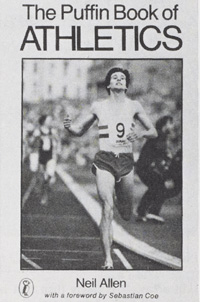 The Puffin Book of Athletics, by Neil Allen, Penguin Books Canada Ltd., Markham, Ont., 1980, 173 pp, $2.50 pb. Forward by Sebastian Coe.
Veteran British sports journalist Allen, former president of International Athletic Writers, put together this slight volume to capitalize on Britain’s participation in last summer’s Olympics. It contains a brief history of track and field, and major athletics competitions, such as the Olympics and the Commonwealth Games; an alphabetical listing of athletic greats, past and present (Diane Jones Konihowski is the only Canadian listed here); athletics rules, techniques, exercises, training tips; a list of world and Olympic records; and a few black-and-white photographs.
Most of the text is highly dispensible, having been covered countless times in more comprehensive books, but the brief historical section does contain some interesting tidbits, albeit from a marked British bias. Among them:
* “The ancient Greeks used to punish a false start in a stade (the origin of stadium), or sprint, with a whipping.
* “Track and field athletics, as we know it, was born in the British Isles,” says Allen. In the 18th and 19th centuries, athletes, usually working class youths, competed for cash prizes and the pleasure of well-heeled gentlemen with money to wager. These early professional competitions produced some remarkable feats. In 1808, for instance, a Scot named Barclay covered 1000 miles in 1000 consecutive hours for a 1000 guinea purse. This early “ultramarathoner” inspired a book on athletics training, in which a recommended training diet emphasized beef, stale bread, mutton, strong beer, and salts, while fish, cheese, butter, and eggs were proscribed.
* Allen pinpoints the birth of amateur athletics at an Oxford-Cambridge meet in 1864.
* The first modern Olympics, held in Athens in 1896, produced one Greek champion, Spirodon Louis, in the marathon. For his efforts, Louis received, among other rewards, free shoeshines for life.
* In St. Louis in 1904, “anthropological events” were held immediately following the Olympics, where untrained blacks and Indians repeated the events on the Games’ calendar for the amusement of the spectators.
* The marathon distance of 26 miles, 385 yards, according to Allen, was not fixed, as is commonly supposed, in ancient Greece; in fact, it came about at the London Olympics of 1908 when the arbitrary distance of 26 miles had 385 yards tacked onto it so the finish line would be in front of the Royal Box.
* In Amsterdam in 1928 doctors examined 3000 Olympic competitors and pronounced Percy Williams, 19, Canada’s gold medallist in the 100 m and 200 m, the perfect physical specimen.
Sebastian Coe’s rather incongruous forward to the book mainly addresses young athletes and advises them when and how they should look for a coach. About the only quotable quote here is a remark Coe made after setting a world record in the mile in August 1979: “I run unconsciously, as if on automatic pilot. I am afraid it is something you have or don’t.” DMcD
 The Complete Book of Sports Medicine, by Richard H. Dominguez, M.D., Warner Books, New York, 1979, $5.95 softcover.
When Murphy uttered his immortal, “If something can go wrong, it will,” he was referring to problems in engineering. Had Murphy been a physician, he might just as well have come up with the same law to describe the human physical condition. Consider some of the exotic ailments to which bodies, and athletes’ bodies in particular, are susceptible: Morton’s toe, chondromalacia, Little League elbow, breaststroker’s knee, Osgood-Schlatter’s disease (with or without an ossicle thrown in), numb penis (a common complaint among cyclists who pedal more than 40 miles at a stretch), swimmer’s ear, lateral collateral ligament injuries, and — god help us — gamekeeper’s thumb.
How to prevent these maladies, and what to do about them if you don’t, is the subject of this well organized, general audience reference book by Illinois orthopedic surgeon Dominguez, whose credentials include being physician to a number of NCAA and AAU football, wrestling, gymnastics, and swim teams.
Unlike some sports medicine buffs, Dominguez is cautious about fads (vitamins, carbohydrate loading, et al.). About as radical as he gets is suggesting caffeine might be a useful pre-competition stimulant. His “miracle drugs” of choice are limited to acetylsalicylic acid — which he enthusiastically endorses for everything from simple muscle pain to sunburn — and good old ice for just about everything else of a minor nature. His common sense advice comes in concise, comprehensible doses and his work is illustrated with easily decipherable diagrams of the seemingly endless ways in which even the most finely tuned body can fall apart.
The problem with the book, and indeed the burgeoning sports medicine industry, is that, often, the simpler the proffered wisdom, the more likely it is to contradict something you’ve read somewhere else. For instance, Dominguez recommends salt tablets in certain warm weather situations, while internationally syndicated columnist Dr. Gabe Mirkin in his popular The Sportsmedicine Book (Champion, March 1979) strongly condemns their use. It seems there is far more consensus among physicians on the treatment of complex orthopedic problems than there is on everyday questions such as whether to pop a salt pill now and then or not. DMcD
New guide indispensable
The Canadian Medical Team Travel Guide, by The Sport Medicine Council of Canada, 333 River Road, Vanier, Ont. K1L 8B9; 126 pp., $5.00 softcover.
Apart from the first section on international medical and paramedical sports protocols, in which we learn, for example, that a knee bandage on a 100 kg weightlifter must be 3 m X 25 cm, the information in this handy guidebook will prove indispensable to almost any athlete, official, or fan travelling abroad.
There are sections on travel documentation, health care and insurance, customs regulations, Canadian embassies abroad (with phone numbers), electrical currents in different countries, major airports (for instance, the proper bus to take from Charles de Gaulle Airport outside Paris to the Gare de l’Est is the no. 350), general information on countries (currencies, populations, etc.), time zone charts, and climate tables for major cities.