
Veteran moves on
by Greg Barr
Try as he might, Canadian amateur boxing champion Ian Clyde cannot remember the name of the fighter whom he met in Austria last July.
It was Clyde’s last amateur international bout — the last time the scrappy southpaw boxer would wear Canadian colours in the ring, the last of well over 100 amateur fights during the past eight years.
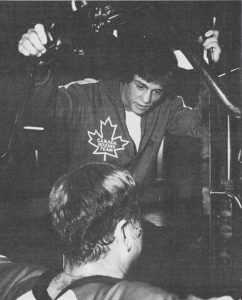
Ian Clyde on the job in an Ottawa health
Ian Clyde au travail dans un club de santé spa. d’Ottawa.
Clyde cannot remember the name of the Austrian who took too many of the Canadian’s punches and in turn lost the bout, not because he has taken too many punches in the head himself, but simply because Ian now has other and more important things on his mind.
While making quick work of a “health food” milkshake and salad at a small table in the dimly-lit snack bar of Vic Tanny’s Health Spa in Ottawa, which he manages and where he works out daily, Clyde is contemplating his good fortune as one of the few amateur athletes in Canada who can now become a professional.
Clyde is bubbling over with anticipation as he considers his good fortune — flights to Los Angeles, the warm climate there, working with one of boxing’s veteran ring masters (Angelo Dundee), a chance at the world flyweight championship if all goes well. There’s the M-O-N-E-Y, too.
“For many of the years I spent as an amateur,” says Clyde, “I really didn’t think of turning pro but later I figured the more time I spent as an amateur, the better my chances would be of succeeding when the time came.”
As Clyde reflected on his amateur career, he recalled some of the pleasures and pains he has felt since he began fighting in international bouts. He says every amateur athlete in Canada must have an inherent drive and a strong will to succeed in order to survive.
After battling a crippling leg disease between the ages of eight and 11, Clyde, a Montréal native, began boxing as a way of conditioning his thin body on the advice of his father who had boxed in the armed forces.
Clyde learned quickly and at the age of 12 began thinking about the Olympics and wondering what it would feel like to stand on the medal podium wearing gold. At 16, Clyde was named an alternate on the Olympic boxing team and although he did not accompany the team to Munich, he remained patient and confident that his time would come.
At the 1976 Olympics in Montréal, Clyde went as far as the quarter finals before losing his chance at a medal. But he insists that this experience was the highlight of his amateur days.
“Despite the number of times you’ve heard this said before,” says Clyde, “it’s very true — being in your own country, hearing a familiar voice in the crowd gives you a feeling you never forget. It makes up for all the bad things you go through.”
Ironically, Clyde fell to his lowest ebb in front of that same Canadian public. It was at the 1978 Commonwealth Games in Edmonton.
There Clyde had his chance at gold, fighting in the finals of the flyweight division against a young African named Michael Irungu. After the final bell, the referee raised Clyde’s hand in victory, which seemed the correct decision considering the Canadian fighter had landed the majority of punches in the contest as dictated by international boxing rules.
But as quickly as Clyde’s hand was raised, the panel of judges reversed their decision and awarded the gold medal to Irungu, with Clyde settling for silver. It hurt.
“I was going to quit amateur boxing and try to turn pro then and there,” recalls an embittered Clyde. “I had beaten Irungu from pillar to post and then the judges took the gold medal away from me. And to make it worse the fans were booing all the decisions, even when they gave me the gold for those few seconds. Canada won more medals at the Commonwealth Games that year than they ever had, so I wonder what the fans were expecting? Why bring all that glory to Canada when your own people are going to dump on you?
After lengthy soul-searching, Clyde decided to try once more for the gold medal, this time at the 1980 Olympic Games in Moscow. At the time of this decision, he said he would knock out everyone in Moscow if that was what it would take to win the gold. He also decided to end his amateur apprenticeship after his trip to the Soviet Union, no matter the outcome.
The Olympic boycott destroyed Clyde’s dream, and yet it was he who spoke out in favour of staying home when the rest of Canada was wallowing in indecision.
“None of the politicians were willing to take a stand right away or were willing to commit themselves,” says Clyde. “Our forefathers sacrificed much more than we have for the freedom of the world. I became convinced that my personal moment in the sun could not supercede the political situation in Afghanistan.”
Clyde agrees that he can be philosophical about the boycott today, considering he is in a position to continue his sport as a pro, while many other Canadian athletes had nowhere else to turn when their trip to the Olympics was cancelled. He is still mystified over the Canadian government’s failure to boycott the Soviet Union through economic and political channels as well as using the athletes as pawns. After all, says Clyde, no one cares about what the Soviets are doing in Afghanistan any more, now that other areas in the world are considered more important trouble spots.
“But in the back of my mind I knew I had something to go on to, with or without the Olympics,” says Clyde. “I feel badly for the swimmers or rowers who were crushed when they were told that their reward for four years of training towards the Olympics was a pat on the back.”
Now, Clyde is ready for the “big time”. He says he has no regrets about his amateur career, and when asked if his amateur days were worth repeating, his answer was a definite “yes”.
“I really enjoyed all of it, everything considered,” he says. “But I hope to continue my success now as a professional. It will take a lot of effort to become world champion, but I feel I have a chance. And I’ll be able to pay off all the debts I collected as an amateur athlete.”
Clyde held a number of odd jobs while trying to support himself and his amateur ideals. He has been a salesman, a truck company dispatcher and any number of occupations which he had to quit to travel to Europe and elsewhere as a Canadian boxer. His advice to young Canadians who wish to become Olympic athletes is to try to have something to fall back on — and an understanding employer is a must, although hard to find.
“You have to have something else open to fall back on,” says Clyde, “no matter how hard it is to train and work at the same time. Being an international athlete is a great way to build character and self-respect. . . and a great way to go broke. Things are improving, with the big companies moving in as sponsors, but if you’re not in a high profile sport, it’s really hard. And retiring Olympic athletes get nothing, so unless they’re assured of some coaching job, they’re out on the streets.”
Clyde recommends that aspiring athletes remain single, unless they marry another athlete who would truly understand the situation. Recently separated from his wife, he says the pressure was just too much and the relationship suffered. Having a wife and no money coming in equals big trouble, he insists.
“If I had a son or daughter who wanted to be an Olympic athlete,” he says, “the biggest thing I would warn him or her about is the stress. If you can’t take the pressure, you won’t make it.”
It is Clyde’s hope that the Canadian Amateur Boxing Association will set up a national training centre, such as volleyball and wrestling have done. He suggests that some sort of school boy boxing system in Canadian high schools would be a good way to feed the national program.
“I’ve learned a great deal in the areas of training, psychology and sport medicine from people not connected with boxing,” says Clyde, “and that seems funny to me. I remember in 1976 that we simply had no clue of how to train properly as a team. I think all amateur sports in Canada, not just boxing, should develop these areas to the maximum. I just think there are some antiquated ideas still around that we should get rid of.”
The wiry young man from Montréal will bring his Canadian Olympic training gear to Los Angeles and wear his red maple leaf proudly as he mixes it up with the local disco dudes in California. He wants the people there to know he is Canadian.
“I was very proud to compete as a Canadian amateur so there is no reason why I should change now,” he says. “I’m leaving a big part of my life behind me. When I see someone else win the amateur title that I held, I know the feelings will all come back to me. I’ll want to be in the ring to defend the title myself.”
Une 2e carrière chez les pros
par Greg Barr
Il a beau essayer, le champion canadien de boxe amateur Ian Clyde n’arrive pas à se souvenir du nom de son adversaire en Autriche, en juillet dernier.
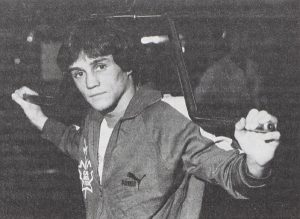
Boxer Ian Clyde
Le boxeur Ian Clyde
Ce fut le dernier combat amateur international de Clyde — la dernière fois que le boxeur gaucher devait porter les couleurs du Canada dans le ring, le dernier de plus de 100 combats amateurs au cours des huit dernières années.
Clyde ne se souvient pas du nom de l’Autrichien qui prit un trop grand nombre de ses coups et perdit le combat, non pas parce qu’il avait lui-même reçu trop de coups à la tête, mais plutôt parce qu’Ian a maintenant des choses plus importantes dans l’esprit.
Tout en avalant un lait fouetté et une salade d’aliments “naturels” au snack bar du Club de Santé Vie Tanny à Ottawa, où il est gérant et s’entraîne quotidiennement, Clyde réfléchit à sa chance; il est l’un des quelques athlètes amateurs au Canada qui puisse maintenant passer professionnel.
Clyde déborde d’impatience et d’enthousiasme devant les possibilités maintenant à sa portée: envolées vers Los Angeles, climat chaud, entraînement sous l’un des maîtres du ring (Angelo Dundee) et, si tout va bien, une chance au titre mondial poids-mouche. Et il y a aussi l’A-R-G-E-N-T.
“Pendant plusieurs des années que j’ai passées comme amateur,” de dire Clyde, “je n’ai jamais vraiment pensé à devenir professionnel. Mais j’ai ensuite décidé que plus je passais de temps comme amateur, meilleures seraient mes chances de succès au bon moment.”
Se remémorant sa carrière amateur, Clyde se souvient des joies et douleurs depuis ses débuts de combattant sur la scène internationale. Selon lui, tous les athlètes amateurs au Canada doivent posséder une détermination naturelle et une forte volonté de succès pour arriver à survivre.
Après avoir vaincu une grave maladie des jambes entre l’âge de huit et onze ans, Clyde, natif de Montréal, commença à pratiquer la boxe pour se mettre en forme, sur l’avis de son père qui avait pratiqué le sport dans les forces armées.
Clyde y prit rapidement goût et dès l’âge de 12 ans, il pensait aux Jeux Olympiques, se demandant ce qu’on devait ressentir sur le podium, avec une médaille d’or autour du cou. À 16 ans, il fut nommé substitut sur l’équipe olympique de boxe; même s’il n’accompagna pas l’équipe à Munich, il était convaincu qu’avec un peu de patience, son tour viendrait.
Aux Jeux Olympiques 1976 à Montréal, Clyde se rendit jusqu’en quart-de-finale avant de perdre ses chances de remporter une médaille. Mais selon lui, cette expérience fut le haut-fait de sa carrière amateur.
“Vous avez sans doute entendu ça très souvent,” explique-til, “mais c’est vrai — être dans votre propre pays, entendre une voix familière dans la foule, c’est quelque chose que vous n’oubliez jamais. Cela compense pour tous les mauvais moments que vous avez dû traverser.”
Ironiquement, c’est devant ce même public canadien que Clyde atteignit le bas de sa carrière. Aux Jeux du Commonwealth 1978 à Edmonton.
Clyde y tenait sa chance de médaille d’or, s’opposant en finale de la catégorie poidsmouche à un jeune Africain du nom de Michael Irungu. Après la dernière cloche, l’arbitre leva la main de Clyde en signe de victoire. La décision semblait être la bonne, compte tenu que le boxeur canadien avait administré la majorité des coups au cours du combat, tel que stipulé par les règlements internationaux de boxe.
Mais dès que la main de Clyde fut levée, le jury renversa la décision et accorda la médaille d’or à Irungu, l’argent à Clyde. Cela fit mal.
“Je voulais lâcher la boxe amateur et devenir professionnel immédiatement,” se rappelle Clyde avec amertume. “J’avais battu Irungu sur toute la ligne et les juges me volaient la médaille d’or. Et ce qui n’arrangeait pas les choses, la foule huait toutes les décisions, même lorsqu’on m’accorda la médaille d’or pour quelques secondes. Le Canada remporta plus de médailles que jamais aux Jeux du Commonwealth, alors je me demande bien à quoi les spectateurs s’attendaient? Pourquoi amener toute cette gloire au Canada lorsque les gens de votre propre pays ne l’apprécient pas.”
Après une longue période d’introspection, Clyde décida d’essayer une fois de plus la chasse à la médaille d’or, cette fois aux Jeux Olympiques 1980 à Moscou. Au moment de prendre sa décision, il affirmait qu’il pourrait battre tous les combattants à Moscou si c’est ce qu’il fallait pour gagner la médaille d’or. Il décidait également de mettre fin à son apprentissage amateur au retour de son voyage à Moscou, peu importe le résultat.
Le boycottage des Olympiques détruisit le rêve de Clyde, mais il fut un de ceux qui se prononcèrent en faveur du boycottage alors que la plupart des gens étaient vautrés dans l’indécision.
“Aucun des politiciens ne voulait prendre position immédiatement ou émettre une décision finale,” affirme Clyde. “Nos ancêtres ont sacrifié beaucoup plus que nous l’avons fait au nom de la liberté. J’étais convaincu que mon heure de gloire n’était pas plus importante que la situation politique en Afghanistan.”
Clyde reconnaît pouvoir se permettre une attitude philosophique face au boycottage, puisqu’il peut pratiquer son sport au niveau professionnel, alors que de nombreux autres athlètes canadiens ne savaient plus où se tourner lorsque leur voyage à Moscou fut annulé. Il ne comprend toujours pas comment le gouvernement canadien ne réussit pas à boycotter l’Union Soviétique sur les plans économiques et culturels en plus d’utiliser ses athlètes comme des pions. Après tout, dit-il, on se moque pas mal maintenant de ce que les Soviétiques font en Afghanistan, depuis que d’autres coins du monde souffrent de problèmes considérés comme plus importants.
“Mais dans mon esprit, je savais que j’avais des débouchés, avec ou sans les Olympiques,” poursuit Clyde. “C’est dommage pour les nageurs ou rameurs qui se sentirent anéantis lorsqu’on leur annonça que leur récompense pour quatre années d’entraînement ardu serait une poignée de main.”
Maintenant, Clyde est prêt pour la “gloire”. Il affirme ne pas regretter sa carrière amateur. Et quand on lui demande s’il recommencerait, il répond par un oui convaincu.
“En fin de compte, cela m’a beaucoup plu,” dit-il. “Mais j’espère remporter autant de succès chez les professionnels. Il faudra travailler fort pour devenir champion du monde, mais je crois que je peux y arriver. Et je pourrai rembourser toutes les dettes que j’ai accumulées en tant qu’athlète amateur.”
Clyde travailla à plusieurs emplois pour survivre pendant ses années de rêves amateurs. Il a été vendeur, a travaillé pour une compagnie de transport de camions et à plusieurs occupations qu’il devait quitter pour voyager en Europe et ailleurs pour représenter le Canada. Il conseille aux jeunes Canadiens qui désirent devenir athlètes olympiques de se garder une porte de sortie. Et un employeur compréhensif est une nécessité, bien que difficile à trouver.
“Il faut prévoir autre chose au cas où,” dit-il, “même s’il est très difficile de s’entraîner et travailler en même temps. Être athlète international est excellent pour se former le caractère et acquérir le respect de soi. . .et un très bon moyen de devenir fauché. Cela s’améliore, grâce aux grandes entreprises intéressées à commanditer, mais si vous ne pratiquez pas un sport populaire, c’est très difficile. Et l’athlète olympique à la retraite ne reçoit rien. Alors, à moins d’avoir une garantie de poste d’entraîneur, il se retrouve à la rue.”
Il recommande aux jeunes athlètes de rester célibataires, à moins d’être mariés à une autre athlète qui puisse vraiment comprendre la situation. Séparé de sa femme depuis peu, il avoue que la tension fut vraiment trop difficile à supporter et que leur relation en souffrit. Il insiste qu’une épouse et pas d’argent signifie de sérieux problèmes.
“Si j’avais un fils ou une fille qui désirait devenir athlète olympique,” poursuit-il, “je le ou la mettrais tout d’abord en garde contre le stress. Si vous n’arrivez pas à y faire face, vous ne réussirez jamais.”
Clyde espère que l’Association Canadienne de Boxe Amateur établira un centre d’entraînement national, comme l’ont fait le volleyball et la lutte. Selon lui, un système encourageant les jeunes boxeurs au niveau des écoles secondaires canadiennes garantirait une bonne relève pour le programme national.
“J’ai beaucoup appris dans les domaines de l’entraînement, de la psychologie et de la médecine sportive de gens qui n’étaient pas impliqués dans la boxe,” de dire Clyde. “Et cela me semble bizarre. Je me souviens qu’en 1976, nous n’avions pas la moindre idée comment s’entraîner de façon adéquate en tant qu’équipe. Je crois que tous les sports amateurs au Canada, pas seulement la boxe, devraient développer ces domaines au maximum. Je crois qu’on utilise encore des principes dépassés dont il faut absolument se débarasser.”
Le jeune Montréalais transportera son équipement olympique canadien à Los Angeles et portera avec fierté sa feuille d’érable rouge parmi les amateurs de disco californiens. Il tient à ce que les gens sachent qu’il est Canadien.
“Je suis très fier d’avoir fait compétition en tant qu’amateur canadien, il n’y a donc aucune raison pour que je change maintenant, dit-il. “Je laisse une grande partie de ma vie derrière moi. Lorsque je verrai quelqu’un d’autre remporter le titre amateur que je détenais, je sais que tous ces sentiments me reviendront. J’aurai envie d’être dans le ring pour défendre môn titre moi-même.”