
Women conquer Himalayan peak
Annapurna: A Woman’s Place, Arlene Blum, Sierra Club Books, San Francisco, 1980, 256 pages.
It has been said that the difference which separates climbers from daredevils is that climbers are cerebral as well as physical. The nature of mountaineering requires climbers to be self-sufficient and meticulous. Routes must be planned, handholds studied and movements must be executed precisely without waste. Psychological profiles have found both men and women climbers to be reserved, forthright and imaginative.
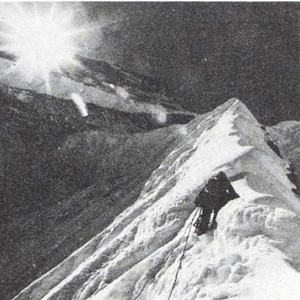 Arlene Blum, author of Annapurna: A Women’s Place, has taken a “mountain” of material and molded it into a straightforward yet poignant account of the 1978 American Women’s Himalayan Expedition to Annapurna. The book shows that both men and women climb mountains for many of the same reasons, with one underlying exception: women climb not only because “it’s there”, but also to break down the prejudice against female climbers which exists in the predominantly male world of alpine climbing.
In describing the American assault on Annapurna, Blum is writing about the world of high altitude climbing. At 26,540 feet, Annapurna is the 10th highest peak in the world and is located in the Himalayas, as are all mountain peaks which soar over 26,000 feet. In 1972, when this expedition was first organized, no female had ever reached the summit of a peak over 26,000 feet. By the time a permit to climb in Tibet had been obtained, however, a Tibetan woman had reached the summit of Everest. Nevertheless, no American woman had ever climbed above 26,200 feet.
Annapurna was selected with the knowledge that it would not be easy. Any high altitude climbing is very risky, with a one-in-10 death rate, and of the 13 parties who had previously attempted Annapurna, only four had succeeded at a cost of nine lives.
The book is written in a pseudo-diary format with the events occurring in chronological order. The reader thus shares the frustrations of preparing for the climb, then the excitement and despair of the climb itself.
Expeditionary climbing is militarily complex, requiring base camps, porters, assault teams and extravagant supplies.
The description of the climb to Base Camp is fascinating. The logistics of building the pyramid of food and equipment needed to put climbers on the summit is staggering. The expedition itself consisted of 10 climbers, two filmmakers, and a Base Camp manager. Porters carried 12,000 pounds of food and equipment and the caravan to Base Camp consisted of 230 people marching for almost two weeks. Not only was this a logistical nightmare — different languages, customs, bureaucratic regulations, and so on — it was very expensive. The expedition cost $80,000, and the money was raised through donations, sponsorships, and T-shirt sales. (The T-shirts, with a picture of a stylized mountain and the inscription, “A Woman’s place is on top . . . Annapurna” were ingenious and raised over $15,000). This section of the book illustrates that climbing these peaks is only part of the challenge and points out that many expeditions have faltered because of faulty planning.
I enjoyed this tale of human frailty attempting to overcome the harsh reality of a mountain. The culture shock of Tibet — porters were paid $2.50 per day, much above the average wage in Tibet — the clashes and frustrations between the climbers and their Sherpa guides who “blackmailed” the expedition into giving them more money and equipment because they were “rich” Americans and female; and the dangers they faced from avalanches, cold and snow, made for an enjoyable late night of reading as I climbed to the summit with the expedition. The thrill of attaining the summit is, however, dampened by the knowledge that Annapurna will claim the lives of two expedition members.
Annapurna: A Women’s Place is a highly readable, biographical account of an American female climbing expedition. I recommend it.
Bob Neill.
Pas de version française